Material Library Reference
Each member references a reusable material definition. Editing that definition
updates every member assigned to it and invalidates results. Split member
segments inherit the original material. The default definition is Steel_A992;
E/G and weight density use the selected units. Materials remain linear elastic;
yield strength and nonlinear constitutive models are not represented. By default,
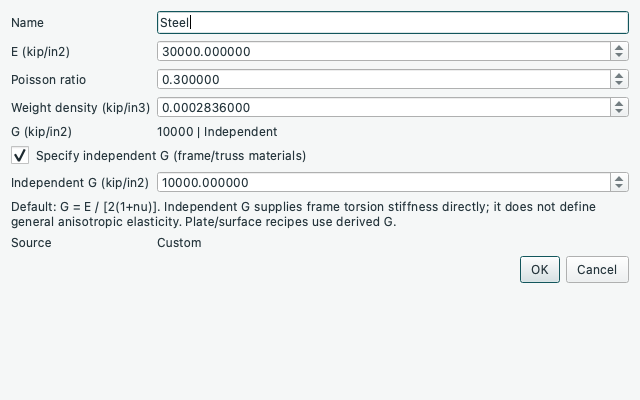
G is derived from E and nu for isotropic elasticity. The optional independent
shear_modulus supplies the frame/truss adapter's G directly, notably for GJ
in spatial torsion, while retaining E and nu. Axial-only trusses use EA, so
changing G does not alter their axial stiffness. This does not define general
anisotropic elasticity. Numerical edits, including independent G, clear library
provenance; a preset cannot claim unchanged library properties with an override.
MCP materials use canonical ksi: shear_modulus: null derives G, and a positive
finite number supplies it. This field is included in model/snapshot identity.
Plate and surface-recipe materials require derived G because the locked shell
formulations recompute it from E and nu; explicit overrides are rejected before
preview/analysis. Their existing recipe formats remain unchanged.
Material-library presets are reference starting points, not certified grades. US steel uses the PyNite Quickstart elastic constants and weight density. EU steel and C30/37 concrete use JRC Handbook 3 (steel Annex Table 2; concrete Chapter VI and Annex Table 9). Aluminum uses the MIT material database. Mass densities for EU steel/aluminum are converted with standard gravity 9.80665 m/s2; the UI and PyNite receive weight density, not mass density. Concrete presets assume uncracked, short-term stiffness. The RC-weight variant changes density only, not reinforcement stiffness. No preset adds cracking, creep, plasticity, yield strength, buckling, or a design-code check. Verify properties for the actual grade, alloy, aggregate, and conditions of use.
Source: GUIDE.md. This manual follows the current repository; the published rc1 wheel has a smaller feature set.