Learning-rate annealing PINN
Documentation index · Measured results
Implemented from Wang, Teng and Perdikaris, Understanding and mitigating gradient
pathologies in physics-informed neural networks, supplied LRA.pdf,
arXiv:2001.04536v1. Algorithm 1, section 2.5, page 10, equations (40)–(42);
the experiment protocol on page 14 updates coefficients every ten iterations.
Authors' repository and paper link.
This implementation follows the supplied v1 pseudocode rather than assuming all
later implementations use the same denominator or smoothing convention.
No authors' code or section 2.6 network architecture was imported.
What changes
LRA adjusts one scalar coefficient per named constraint loss. It keeps the PDE reference weight fixed. It is not an Adam base-learning-rate decay schedule and it is not SA-PINN's learned per-point squared mask. All ten existing pointwise architectures remain available, with the same network factory and settings.
Let R = w_pde MSE_pde and B_i = w_i MSE_i, including Margam's user-specified static weights. The training objective is:
L = R + sum_i lambda_i B_i
lambda_i initially = 1
lambda_hat_i = max_theta |gradient R| / mean_theta |gradient B_i|
lambda_i = (1-alpha) lambda_i + alpha lambda_hat_i
Alpha weights the new estimate (default 0.9). The denominator does not include the previous lambda_i. Max/mean are taken over all trainable scalar parameters, including biases and zero entries for unused parameters, not an unweighted average of layer means. Coefficients are detached statistics, not trainable tensors. Adam takes one descent step on L.
With interval 10, balance occurs before updates 1, 11, 21, …, using the current network. The absolute update counter survives worker batches, stop and resume. The base Adam rate stays at the selected value (recipe default 0.001).
For scalar problems each named side is its own constraint; in coupled flow each named side/component and the pressure gauge have their own coefficient. The three flow PDE residual columns remain one existing PDE MSE. This grouping and Margam's static weighting matter: interval BC weight 1 means static weight 0.5 per endpoint. It is not the paper's specific aggregated-boundary experiment.
Numerical safeguards and limits
A denominator at or below lra_epsilon holds its previous coefficient; default
1e-12. Otherwise the ratio is capped at lra_max before smoothing. The generic
recipe uses cap 1e6; the runnable Poisson example explicitly uses cap 100.
These guards are practical additions to Algorithm 1, not paper equations.
There is no positive lower coefficient floor. Nonfinite physical losses,
statistics, objective or network gradients abort before Adam or balancing state
is advanced.
Small boundary gradients can produce large coefficients and stall PDE fitting. The saved equal-budget comparison includes both caps rather than presenting LRA as an automatic accuracy improvement. Full-batch fixed samples/MSE/Adam are supported; no paper architecture, minibatch/resampling scheme, L-BFGS stage or paper benchmark reproduction is claimed. CPU validation does not verify CUDA.
Desktop use
- Open File → Examples → 1D examples → Poisson — LRA-PINN.
- Select LRA trainer to edit steps, base rate, static weights, alpha, update interval, cap and gradient floor. Select the separate Neural network to replace its architecture. The example uses FCNN 16×16, 32 grid points and 2,000 updates.
- Alternatively choose File → Insert PINN recipe → Learning-rate annealing PINN · compact / expanded. Physics, sampling, geometry and output blocks stay external. Expand to access the cap and floor; collapse preserves all settings.
- Train, then explicitly open a connected Training Monitor or Comparison. Right-click the trainer/compact recipe for LRA loss-weight summary. No output view opens automatically.
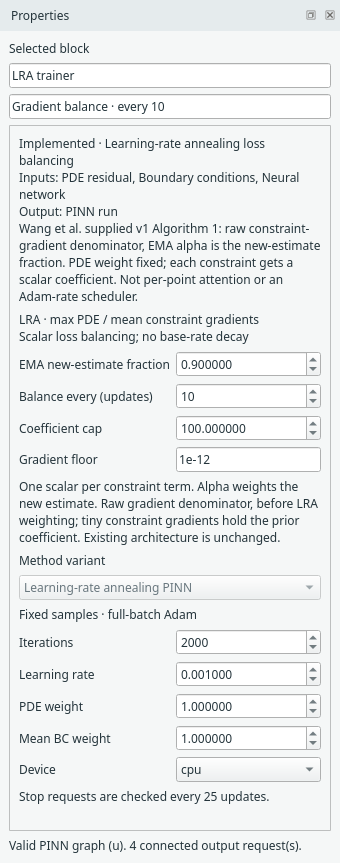
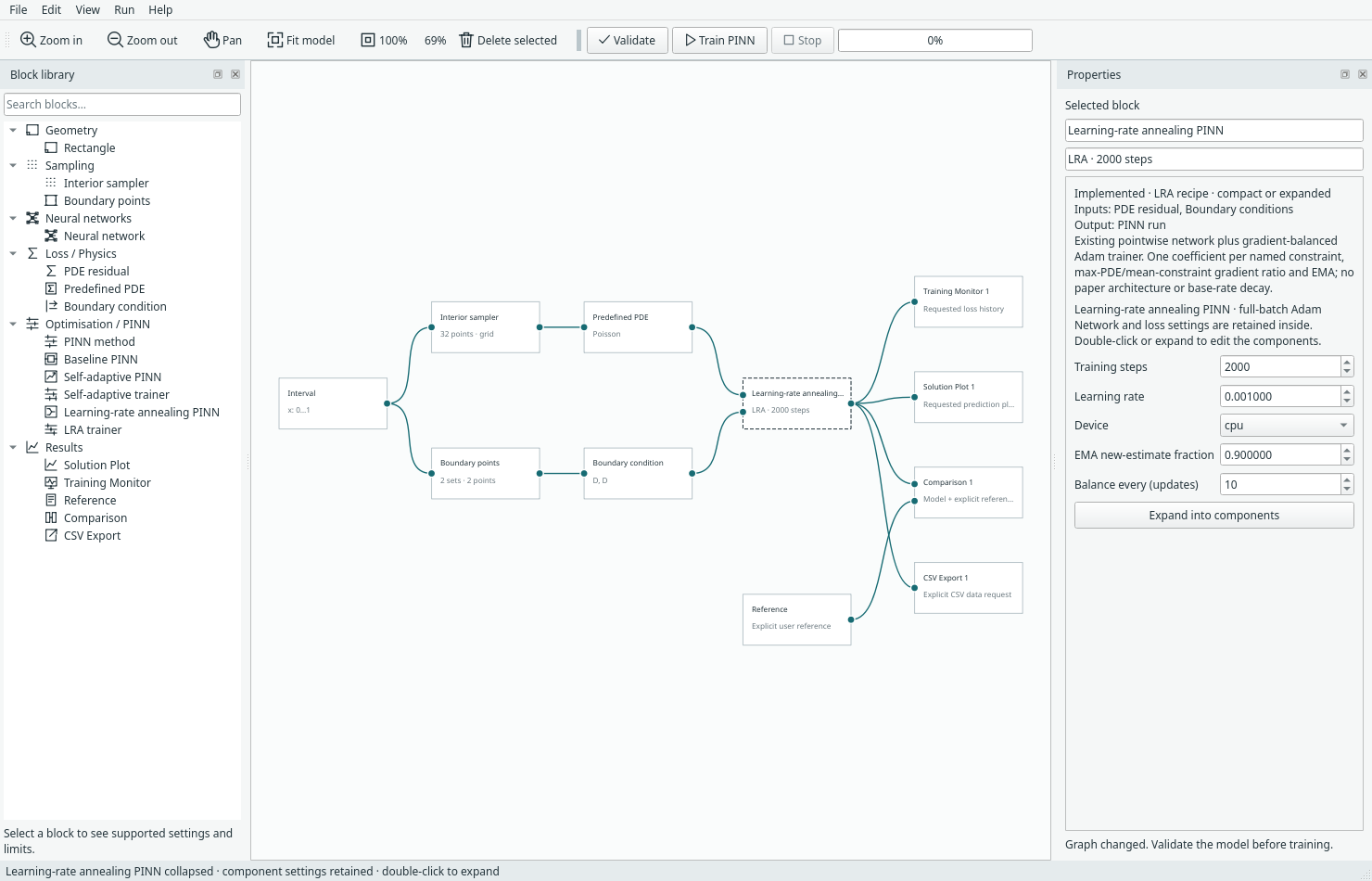
Monitor PDE and BC curves remain raw physical MSE; total includes changing LRA coefficients and cannot be compared directly across methods as an error score. The summary shows coefficients and effective static-times-LRA weights. Full statistics/targets/coefficients at every balancing event are in checkpoint state.
Code and persistence
- Method:
margam/methods/learning_rate_annealing.py. - One-file recipe:
margam/recipes/learning_rate_annealing.py. - Example:
margam/templates/examples.py::example_config('lra_poisson'). - Compare:
.venv/bin/python -m examples.compare_lra --iterations 2000. - Test:
.venv/bin/python -m unittest discover -s tests -p 'test_lra*.py' -v.
Model format 12 reads formats 1–11. Run format 2 stores ordinary network/Adam state plus LRA settings, current coefficients and balancing history. Restricted loading validates the ratio, smoothing, term names and update phase. Actual resume also checks original data fingerprints and network architecture. A changed algorithm setting, architecture, or data cannot silently resume the old run. Tests cover the exact raw-gradient ratio and EMA, cap/zero guards, nonfinite aborts, batching/resume equality, all ten networks and a coupled-flow smoke run, and real desktop insertion/expand/collapse/clipboard/undo/model/run lifecycle.
The optional integral loss formulation applies physical measures before LRA computes term-gradient statistics. Mean MSE remains the default. The coefficient update algorithm and network architecture do not change.