Networks and PINN methods
The network maps coordinates to fields. The PINN method determines how physical losses participate in training. You can change one without replacing the whole problem.
Choose the network
Select the Neural network block and open Architecture. In a compact recipe, expand it first to expose the network.
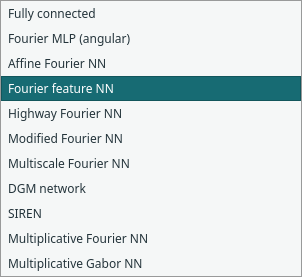
The architecture dropdown offers ten supported pointwise networks. Open full size.
The choices include the original fully connected model, Fourier variants, DGM, SIREN and multiplicative Fourier/Gabor networks. These are pointwise networks, not neural operators. Architecture-specific controls appear below the choice. Changing architecture resets its own options and is one undoable edit.
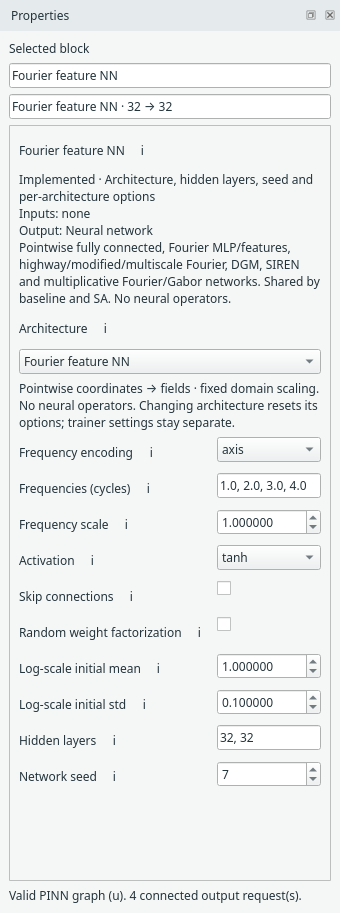
The existing Fourier network exposes encoding, frequencies, scale, activation and hidden widths. Open full size.
Fourier frequencies are measured in normalised domain coordinates. The displayed Helmholtz example deliberately includes the known oscillation modes; it is not an automatic frequency search. SIREN has its own omega controls. Use the network reference for each option's definition.
Find the right settings group
| Inspector group | Responsibility |
|---|---|
| PINN method | Variant, physical loss weights and method-specific adaptation |
| Optimisation | Network Adam learning rate; SA has a separate mask Adam rate |
| Trainer | Number of updates and device |
The sections currently have clear headings; they are not collapsible controls. Do not confuse these inspector groups with the Block library categories.
Baseline, hard Dirichlet, SA and LRA
Baseline uses fixed weighted physical losses. The hard-Dirichlet variant enforces its supported equal constant boundary values through a box transform. SA learns per-point squared masks and has a separate Adam ascent optimiser. LRA adjusts scalar constraint-loss coefficients using gradient statistics.
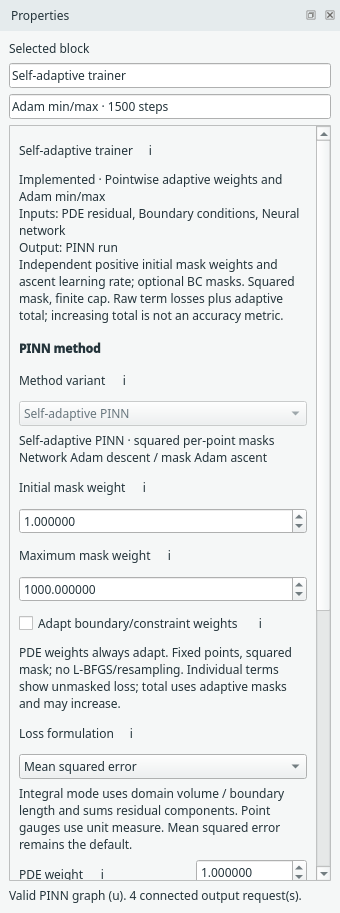
SA separates method controls, network Adam descent and mask Adam ascent. Open full size.
LRA does not decay Adam's base learning rate. Its balancing interval and EMA belong to Method; the network's Adam rate belongs to Optimisation. The LRA guide and SA guide give exact update rules and checkpoint requirements.
Choose a method to explore; the software does not promise that one will be more accurate on every problem. User-selected budgets and settings are retained when recipes are expanded/collapsed, saved and reopened.
Next: Train and inspect results.
Select a trainer or compact recipe to choose Loss formulation. Mean squared error remains the default; the optional integral formulation uses domain volume and boundary lengths. It works with the existing architectures.